Catalog of construction and finishing materials for home renovation
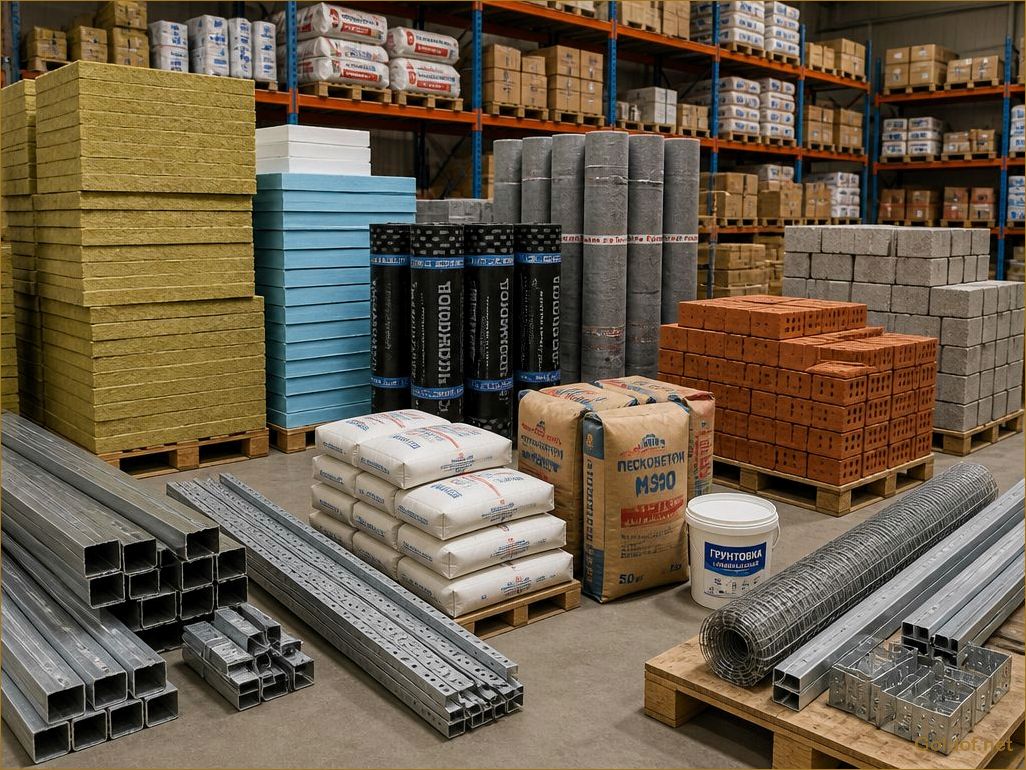
The catalogue of building and finishing materials is your reliable assistant in the world of repair and construction. Hundreds of items are collected in one place: from ink mixtures and insulators to decorative plaster, tiles and finishing coatings. Convenient structure by categories, filters by price, brand and characteristics allow you to quickly find what you need. Each product is accompanied by detailed descriptions, photos, technical parameters and tips for use. Compare, choose and order in a few clicks – without market trips and unnecessary doubts. With our catalogue repair becomes a simple, understandable and truly exciting process!
Content of the article:
For bathrooms and kitchens, I recommend a moisture-resistant 12.5 mm gypsum board with a density of 800-900 kg / m³: it withstands increased humidity up to 80-90% and when installed on a metal frame with a soundproofing lining provides a noise reduction of about 30-35 dB. Mount the panels on the screwdrivers with a step of 200 mm, fill the seams with a moisture-resistant spatula composition, grind the spatula with a grain of 120-150.
For the laying of ceramic tiles, use cemented adhesive class C2 (EN 12004) with the addition of polymers for elasticity; apply a toothed spatula 4×4 or 6×6 mm depending on the size of the tile – the consumption of 3-5 kg / m2. The open time of the glue is about 15-25 minutes at 20 ° C, withstand tile adjustment in the first 10-15 minutes. For filling seams in wet areas, choose an epoxy plaster with a seam width of 2-8 mm (flow rate of 250-400 g / m2), in dry rooms, cement plaster with water repellent additives is possible.
Before painting, apply a deep-penetrating acrylic soil on the absorbent bases, dilute with water according to the manufacturer’s instructions (usually 1:3 for highly absorbent surfaces), drying time 2-4 hours at 20 ° C. For the finishing layer, choose an acrylic matte paint with a flow of 8-10 m2 / l; most often enough two layers with a normal coating of each layer 12-20 μm. Operating temperature when applying 5-30 °C, relative humidity 40-60%.
Waterproofing in “wet” areas perform 2-component cement compositions: apply at least 2 layers with a total thickness of 1.5-2.5 mm, the duration between layers 4-8 hours, full readiness for further finishing – in 24-48 hours. For balconies and exterior joints, choose self-adhesive membranes or liquid rubber with at least 100% elasticity.
For thermal insulation of walls, use mineral wool with a density of 40-60 kg/m³ and a thermal conductivity of about 0.035 W/(m·K); 50-100 mm thickness gives a noticeable reduction in heat loss. Under the floor screed, use XPS with a density of ~30 kg / m³ and a compressive strength of 300-400 kPa; minimum thickness under intense load – 30-50 mm. Lay insulation with minimal cold bridges and glue joints.

When laying parquet and solid board, use polyurethane or MS-polymer adhesives with a flow of 0.7-1.0 kg / m2 when applying a comb; Before laying, keep the wooden elements indoors for 48-72 hours at 18-22 °C and relative humidity of 45-60% to adapt to the microclimate. Fix the deformation seams along the perimeter and near stationary structures, leaving gaps of 8-12 mm depending on the length of the floor.
Observe the sequence of work: draft structures and partitions → engineering networks (plumbing, electricity) → waterproofing and thermal insulation in “wet” zones → leveling mixtures and screws → finishing coatings. Check the cost and conditions of use of each material according to the manufacturer’s passport, check the temperature and humidity before application, and perform test sections if adhesion is suspected.
Selection of materials for room purpose: requirements for moisture resistance, wear resistance and fire safety
For bathrooms and showers, choose ceramic granite with water absorption ≤0.5% and provide two-layer waterproofing with a total film thickness of not less than 2 mm.
Wet zones (bath, shower, toilet)
Walls: use cement-chipboard or waterproof gypsum board only at a relative humidity of up to 70-75% without direct contact with water; in the shower area and around the bath apply cement slabs or cement-polymer panels. Apply adhesion-enhancing primers and cemented or elastic tile adhesives class C2 according to EN 12004.
Floors: ceramic granite with water absorption ≤0.5% and PEI 3-5 (PEI 4 for frequently used family bathrooms). Place the waterproofing under the tile – sheet or two-component liquid, control the joints and inputs of communications with steam cuffs.
Seams and gaskets: use elastic epoxy or polyurethane gaskets for moisture and chemical resistance; treat the intersecting seams with a sealant with adhesion to the coating.
Kitchen and cooking areas
Apron: conceal moisture and grease with ceramic granite or tile with water absorption ≤3% and resistance to frequent wet cleaning (paints according to EN 13300 washing class 1-2 for painted aprons).
Floor: in the working areas, choose PEI 4-5 or AC4-AC5 laminate; In the lunch, allow AC3 with moderate load. For wooden floors, look for solid rocks (oak, ash) and protective varnishes with wear resistance on the manufacturer’s tables.
Waterproofing and substrates: in places of possible leaks, apply local waterproofing, use moisture-resistant OSB / WBP plywood for floors with increased humidity.
Apron: water resistance ≤3%; local waterproofing at the sinkPEI 4–5 or laminate AC4–AC5; commercial floor in high traffic areasLaminate AC3-AC4, parquet with protective varnish; for children – abrasion-resistant coatings
| Location | Moisture resistance (threshold) | Durability (recommended) | Fire Safety |
|---|---|---|---|
| Bathroom/Shower | Tile: water absorber. ≤0,5%; waterproofing ≥2mm(two layers) | Floor: PEI 3–5 (PEI4 for family bathrooms) | Wall materials are non-flammable; finish – class according to EN 13501-1 A1–A2 |
| Kitchen (working area) | Pole: PEI 4–5 or AC4–AC5 laminate | Panels and aprons – non-flammable or B-s1,d0 in open planning | |
| Arrival/Corridor | Moderate moisture resistance; street moisture protection | Use materials not lower than class B (EN 13501-1) | |
| Living room/bedroom/children | Normal moisture resistance of finishing; moisture-resistant panels in the window and near air conditioners | Textiles and upholstered furniture – fire safety certificates, fabrics with flame retardant treatment | |
| Balcony/loggia | Tile or frost-resistant ceramic granite; waterproofing and steam insulation | PEI 3-5 depending on use | Exterior lining materials – non-combustible or difficult to burn |
| Basement/technical room | Materials with low water absorption and resistance to capillary moisture | Moisture-resistant floors, PEI tile 4–5 | Materials and cable channels must meet fire protection requirements for auxiliary premises |
Practical advice: apply grade C2 adhesives for wet and warm floors, apply primer for waterproofing, use steam insulation in case of temperature fluctuations, and for textiles and finishes in children’s and public areas, require fire response certificates and s/d (smoke/drop) markings according to EN 13501-1.
Check the technical passport and marking: water absorption, PEI, AC, EN 13501-1, EN 13300 and certificates of compliance with local fire safety standards before purchasing.
We have collected for you only proven brands and current market innovations, so that the repair will enjoy the result for many years. Explore collections, be inspired by ready-made solutions, plan your budget and create the space of your dreams. Open the catalog – and let each page bring you closer to the perfect interior!
